Features
A filterable library, a queue, and a record of what happened
The product is a table of directories with measured fields, a shortlist you build from it, a queue you hand to your own agent, and a record of what came back. Everything below describes one of those, what it is measured against, and the line where it stops.
Your AI agent submits your product to 1,000+ directories, and LaunchFilter checks each listing went live.
The library is the product
Each directory gets a row, and each row carries the fields that decide whether a submission is worth an evening: the fee label the directory prints, the link type measured on a live listing, whether the form sits behind an account, the domain rating with its source, a monthly visit figure for a named month, whether a badge is required, and the date the row was last checked. The fields were read from the directory itself rather than copied from a round-up post.
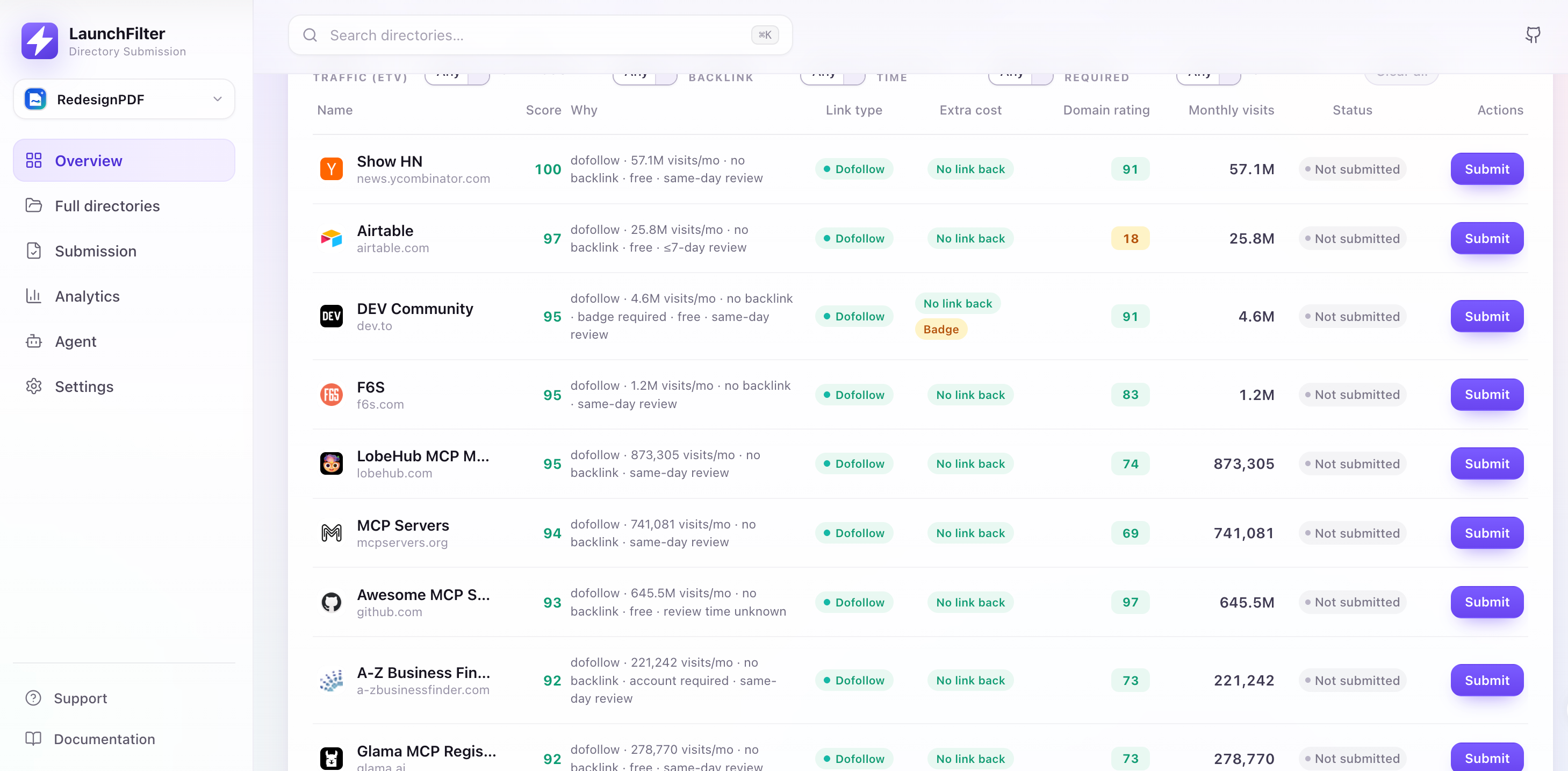
A field that could not be confirmed is left empty instead of filled with a plausible value. That rule is what makes the table usable. A blank tells you the directory does not state the thing you are asking about, so you should either check the submit page or treat the row as a question rather than an answer. A table full of confident guesses reads better and is worth less.
Filters remove rows, they do not score them
Every recorded field is a filter: fee label, link type, login requirement, badge rule, stated approval time, category, entry type, domain rating, monthly visits, and the last-checked window. Filters combine, and each one removes rows rather than adding points. The result is a set you can defend, not a ranking you have to trust.
Link type and the login flags do most of the work. Link type decides whether the pass is about search visibility or about referral traffic and proof of presence, and those are different purchases. Login and captcha flags decide how long each row will take, which decides how many rows will fit in the sitting you actually have. Filtering on both before you look at anything else keeps the queue honest about what it will cost.
A shortlist is a decision you can defend
A shortlist is the subset of filtered rows you have decided to act on. It survives a page reload, it belongs to a pass rather than to a browsing session, and it is small on purpose. The library can hold a large set; the shortlist should hold what you can finish and verify before the week ends.
Keeping the shortlist separate from the library matters for a mundane reason: a table you are browsing and a set you have committed to look identical on screen but behave differently. One is a question, the other is a plan. When a shortlist is finished, it becomes the queue, and the record of the pass starts from there.
The queue is a hand-off, not a submission
The queue is structured data: one entry per shortlisted directory, carrying the site, its submit URL where one exists, the category you chose, the values you prepared, and the flags that change the work, such as a login wall, a captcha, or a badge requirement. An agent with browser control can read that and work through the forms in a session you are already signed into.
Because the queue is data rather than a script, it can be handed over more than once. If an agent stops halfway, the entries it finished carry a state and the entries it did not are still queued. Nothing in the queue opens a form by itself, and nothing is sent until the agent acts on an entry.
A state per row: queued, live, or blocked
Every row in a pass ends queued, live, or blocked. Queued means it is in the queue and nothing has been sent. Live means a listing was found at the directory after the attempt. Blocked means the attempt stopped before completion, with the reason recorded: an account was needed, a captcha could not be passed, the form was closed, or the submission was refused.
One state per row, not a status history buried in a log. The point is to open the pass a week later and see, without reconstruction, where the work stopped and why. A blocked row with a reason is more useful than a failed attempt with none, because the reason decides whether the row is worth another try.
The last-checked date is part of the row
Rows are re-verified rather than assumed, and every row shows when it was last checked. The library reports its data day as Nov 23, 2026, so you can tell how far the whole set is from today, and you can tell which rows are older than that. An old row is not wrong. It is unconfirmed, and it should be read that way.
Age matters most for the fields that directories change quietly: the fee, the badge rule, the review time, and whether the form still exists. A directory can rearrange its submission page without announcing it. If a row predates the last redesign you can see, open the submit page before you trust the flags.
Fee, recorded as the directory states it
Fee is a label, not a calculation: free, freemium, or paid, as printed by the directory. 980 rows carry one, of which 163 are labeled free and 211 paid. A paid label can cover a one-off listing fee, a subscription, or a review fast-track, and the row does not pretend to know which; it reports what the page says.
Read the fee next to the badge rule, because the fee and the badge rule are the same question asked in different currencies. A free lane that requires a permanent link back on your site is not free in the sense most founders mean. The row puts both fields side by side so the trade is visible before the form is opened.
Link type, measured on a live listing
Link type is read from an outbound link on a live listing in a comparable category, not from the submit page's description. 612 rows currently resolve to a followed link; the rest resolve to nofollow or stay unresolved because no live listing could be found. Unresolved is a distinct answer, and it is left visible rather than collapsed into either bucket.
Submit pages are an unreliable source here. Some omit the attribute, some describe last year's policy, and some genuinely change their mind. Measuring after publication is slower, and it is the only way to report what a listing actually does rather than what a directory says it will do.
Login and captcha flags change what a row costs
A login wall means an account has to exist before the form does. A captcha means a human has to be present at the moment of submission, or the attempt stops. Both flags are recorded per row, and both are about cost rather than quality: they tell you how much of the sitting a single directory will take, and whether an agent can finish it alone.
Use the flags to order the queue. Rows without a wall go first, while attention is fresh; rows with a wall are grouped so the sign-in and the form happen in the same visit rather than across separate sittings. That ordering is the difference between a pass that finishes and a pass that leaves a tail of half-completed attempts.
Domain rating and monthly visits are context
Domain rating comes from a named third-party source, and monthly visits are a measurement for one named month. Neither is a verdict. A high rating on a directory that never approves a product like yours is a number about the directory's own link profile, not about your chances. A low visit figure can still be the right audience.
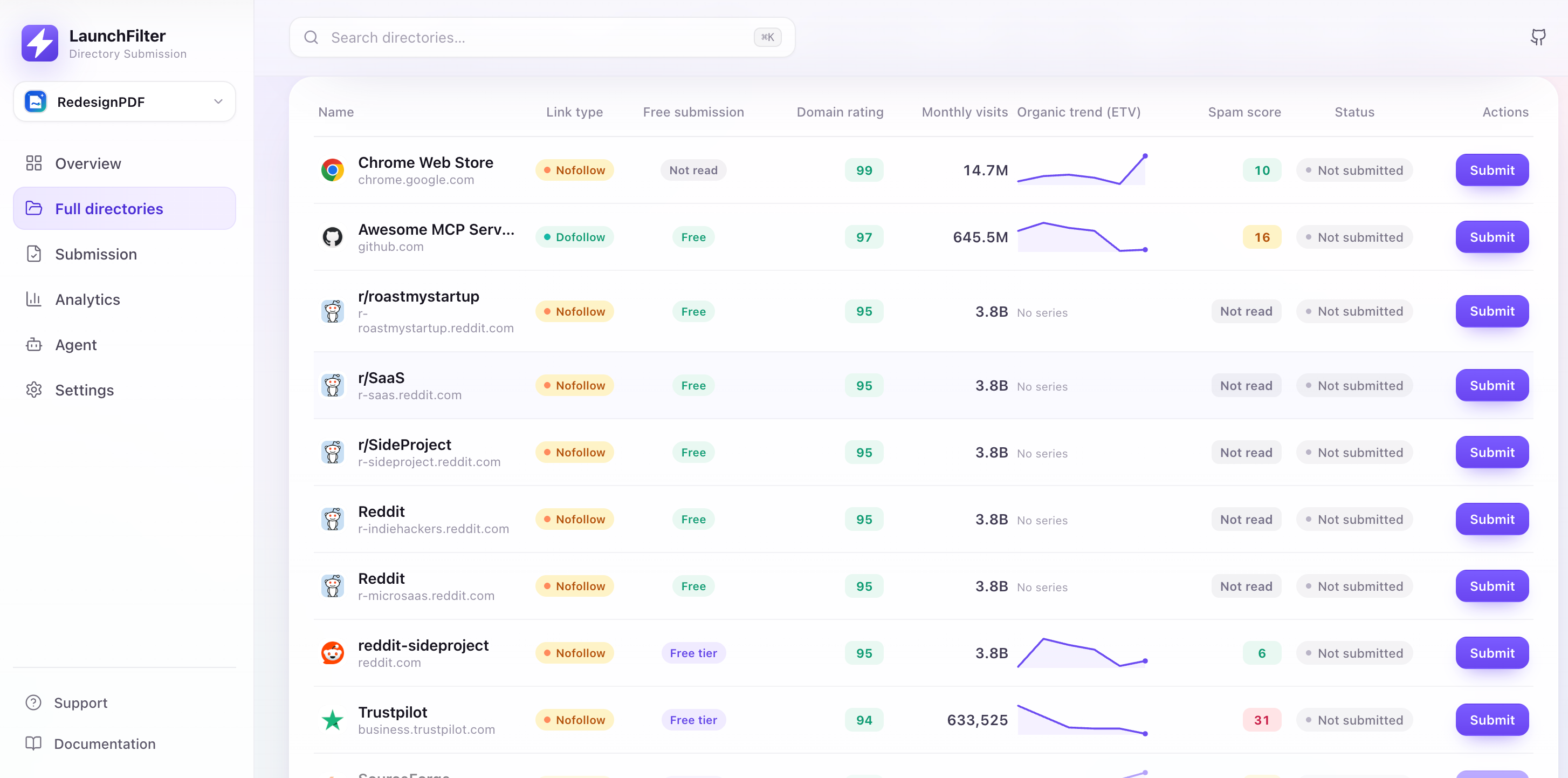
Where they earn their place is as tie-breakers. When rows pass the same filters and cost the same effort, the row with more measured traffic and a stronger profile is the better first attempt. Where a visit figure is missing, the field means no data for that month, not an audience of none.
Badge and link-back rules sit next to the fee
297 rows ask for a badge or a link back before they will list you. The rule is recorded as the directory states it, including the awkward middle case where a badge is requested rather than required. That distinction decides whether the cost is a permanent footer slot or a suggestion you can decline.
The cost is easy to underestimate because it is paid in layout rather than money. A badge stays on your site after the listing is live, and it stays after the directory stops sending visitors. Deciding that in advance, per row, is cheaper than deciding it later for a page you have already published.
What the workspace keeps, and what it never holds
The workspace keeps the queue, the state of each row, the reason a row is blocked, the date of the attempt, and any note you add. That record is the part that makes a second pass cheaper than the first, because it answers the question a fresh list cannot: what did this directory do last time.
It never holds directory passwords, payment card details, or a session token for a site you have not signed into. It does not file a form under your name, and it does not buy a link or a placement. Those absences are the product's design, not its backlog, and they are the reason the record can be shared without handing over an account.
Where the library stops
It is a large working set, not a census. Directories open, close, change hands, and stop accepting submissions, so a claim of completeness would be wrong within a month. Rows are chosen for whether a founder could plausibly submit to them, then measured; a missing directory is a gap to report, not evidence that it does not exist. The set is rechecked rather than frozen, and gaps close when someone reports them.
It is also not an SEO instrument. A listing is a page that exists and may be crawled. Whether it is indexed, whether it ranks, and whether it sends visitors are separate questions, and the library measures the directory rather than promising an outcome. The guides cover what to do with a row once you have one; the library covers whether the row is worth the form.
FAQ
What is LaunchFilter, in one sentence?
A directory library for founders: a filterable table of startup directories where each row carries measured fields, a shortlist you build from that table, a queue you hand to your own agent, and a record of what came back. It is not a submission service and it is not a link seller. The decision about where to submit stays with you, and the typing can be delegated to an agent you already run.
Does LaunchFilter submit to directories for me?
No. The queue is handed to an agent you control, working in your browser with your own accounts, and the product records the outcome. There is no ghost submission, no stored directory password, and no paid placement. That is a deliberate boundary rather than a missing feature: the account, the copy, and the judgment about whether a directory fits should stay with the person whose product it is. Nothing is sent until you or your agent acts on an entry.
What does each directory row record?
A fee label as the directory states it, the link type measured on a live listing, whether the form needs an account, the domain rating with its source, a monthly visit figure for a named month, whether a badge or link back is required, and the date the row was last checked. Category and entry type are recorded as well. A field that could not be confirmed stays blank rather than being filled with an estimate.
What does a blank field mean?
It means the library does not know. A blank fee is not a free directory, and a blank link type is not a nofollow. Some directories publish nothing about price or review time, and inventing a value would make the row look more useful than it is. Treat a blank as a question for the submit page, and if you learn the answer, note it for the next pass. A blank is a question, and questions are cheap to ask before the form is open.
Can I filter by fee and link type together?
Yes, and that combination is the most common first filter. Fee and link type answer different questions: what a listing costs, and what the link is worth once it exists. A free row passing nofollow and a paid row passing dofollow are solving different problems, so filtering on both forces you to say which problem you are solving this month. Filters remove rows; they do not score them, and if the answer changes next week the filter was probably too narrow.
How is link type measured?
By opening a live listing in a comparable category and reading the attribute on its outbound link, rather than by trusting the submit page. Submit pages often omit the attribute or describe an older policy. Where no live listing can be found, the row stays unresolved instead of assuming either answer. A followed link can become nofollow after a redesign, which is why the last-checked date sits beside the field. Read it as a measurement with a date, not as a permanent property of the directory.
How current is the data?
Every row carries the date it was last checked, and the library reports its data day as Nov 23, 2026. Rows are re-verified rather than assumed, and old rows look old, so you can decide how much to trust a line before acting on it. A row checked before a directory's last redesign may describe a form that no longer exists. Re-open the submit page on the day you submit. The date is the part of the row that tells you how much of the rest to believe.
What do queued, live, and blocked mean?
Queued means the row is in your queue and nothing has been sent. Live means a listing was found at the directory after the attempt. Blocked means the attempt stopped, with a reason recorded: an account was needed, a captcha stopped it, the form was closed, or the submission was refused. The states describe your attempt rather than the directory's quality. A blocked row is information, not a failed pass. If a state and the page disagree, the page wins.
Does the product store my passwords?
No. It does not ask for them and has nowhere to put them. When a directory needs an account, your agent uses a session you are already signed into, or the row comes back blocked and you finish it yourself. Holding credentials for a large number of third-party sites would create a liability much larger than the time it saves, and it would make the product responsible for accounts it does not own.
Can I hand the queue to an agent I already use?
Yes. The queue is structured data: each entry carries the directory, its submit URL, the values you prepared, and the flags that matter, such as a login wall or a captcha. An agent with browser control can read that and work through the forms in your session. The product does not run the agent, does not choose its model, and does not watch the pages it opens. What comes back is a state per row, not a transcript of every field it typed.
Does a live listing guarantee traffic or ranking?
No, and nothing here should be read as a promise of either. A listing is a page that exists and may be crawled. Whether it ranks, whether it sends visitors, and whether the link passes value are separate questions with separate answers, and none of them is settled at the moment of approval. The library measures what a directory does now; it cannot forecast what a search engine does later. A pass is a measurement, and the number that matters arrives later.
Is this every startup directory that exists?
No. It is a large working set, not a census. Directories open, close, change hands, and stop accepting submissions, and a library claiming completeness would be wrong within a month. Rows are chosen for whether a founder could plausibly submit to them, then measured. If a directory is missing, that is a gap worth reporting rather than evidence that it does not exist. The set is rechecked rather than frozen, and gaps close when someone reports them.